

Most service business owners believe growth is a hustle problem. Work more hours, land more clients, and eventually things will click. But that framing is what keeps founders stuck. Understanding what is a service business growth stage means recognizing that each phase of your business demands a completely different set of priorities, skills, and structures. Burnout is a systems problem, not a willpower problem, and the founders who scale without breaking themselves are the ones who treat growth as a structural challenge rather than a personal one.
Table of Contents
- Understanding the concept of service business growth stages
- The five common stages of service business growth and their priorities
- Why system-building and delegation define your growth stage
- Practical timeline for scaling your service business effectively
- Common growth traps and how to avoid them by recognizing your stage
- Why the real bottleneck in service business growth is your mindset about systems
- How Bizfinite helps service businesses master growth stages and build systems
- Frequently asked questions
Key Takeaways
| Point | Details |
|---|---|
| Growth stages explain business evolution | Service businesses progress through defined stages where priorities shift from founder work to systems management. |
| Systems reduce founder burnout | Building documented processes and delegation systems helps founders avoid burnout and unlock sustainable growth. |
| Delegation should be gradual | Effective growth requires step-by-step delegation with review checkpoints to build trust and team capability. |
| Fix Setup, then Sales, then Scale | Addressing foundational lead generation, then sales systems, then operations in order prevents chaos and stalling. |
| Mindset shift drives scaling | Becoming a CEO who builds and trusts systems is the hidden key to moving through growth stages successfully. |
Understanding the concept of service business growth stages
Growth stages are not just milestones on a revenue chart. They describe how your business fundamentally operates and who is responsible for what. In the earliest stages, you are the product. You do the selling, the delivering, the invoicing, and the follow-up. That is normal and even necessary at first. But if your business still runs that way two or three years in, you have not grown a business. You have built a job with extra stress.
Early-stage service businesses are characterized by founder-heavy execution and minimal systems, while later stages shift the founder's role toward building and overseeing systems. The phrase that captures this shift well is "effort to infrastructure." You stop being the engine and start being the architect.
Here is what changes at each level of the service business lifecycle stages:
- Constraints shift. Early on, your personal hours are the ceiling. Later, your systems become the ceiling, and systems can be expanded far more easily than your time.
- Your role changes. You move from doing client work to managing people who do client work, and eventually to leading the people who manage those people.
- Decision-making evolves. Early decisions are reactive and daily. Later decisions are proactive, strategic, and monthly or quarterly.
- Revenue sources diversify. Founder-generated revenue gives way to team-generated revenue, which is the only kind that truly scales.
Identifying growth stages of a service business is not about ego or bragging rights. It is about diagnosing where your real constraints are so you can fix the right problems. You can find a service business systems platform that helps you build these structures without needing to piece together ten different tools.
The five common stages of service business growth and their priorities
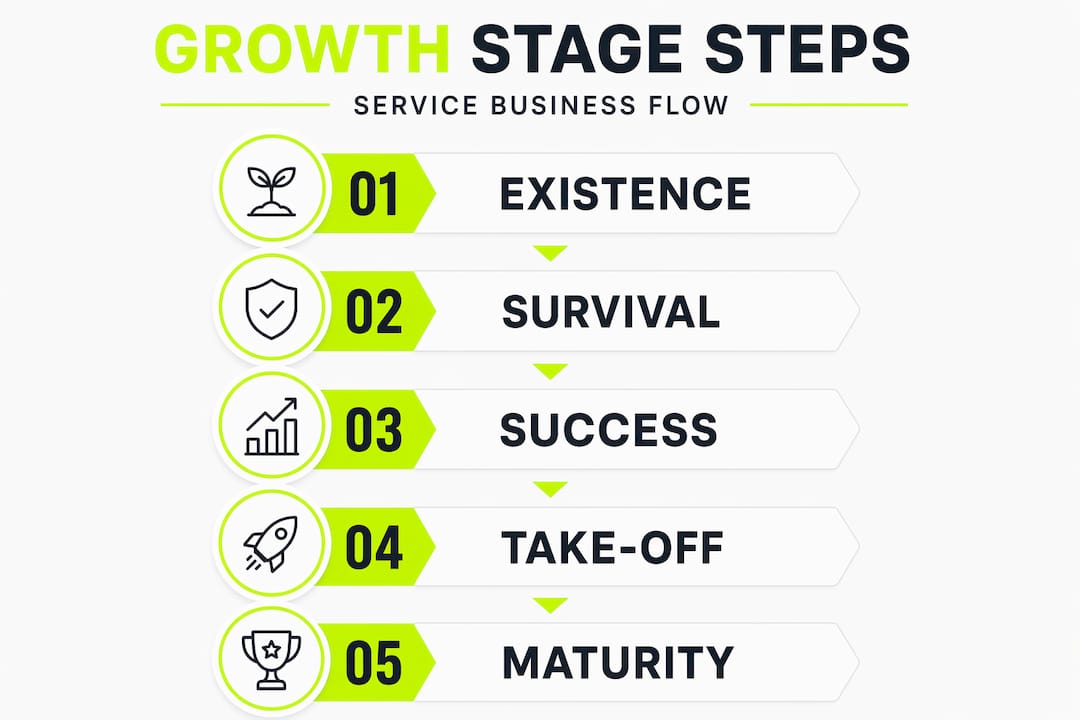
To make these ideas tangible, let's explore the specific stages your service business will likely pass through. Business growth stages explained through a clear framework give you a map instead of a mystery.
Growth phases commonly progress from existence to survival to success to take-off to resource maturity, with each stage changing what you prioritize from cash and system setup early to scaling and control later.

| Stage | Primary focus | Biggest challenge | Key question |
|---|---|---|---|
| Existence | Getting first paying clients | Proving the service works | Can I deliver and get paid? |
| Survival | Stable cash flow | Covering costs consistently | Can I stay in business? |
| Success | Systematizing delivery | Choosing growth vs. stability | Do I want to scale or stay comfortable? |
| Take-Off | Rapid expansion | Managing quality and team | Can my systems handle the volume? |
| Resource Maturity | Professional management | Avoiding complacency | Am I still innovating? |
Here is what each stage actually feels like from the inside:
- Existence is chaotic and exciting. You are wearing every hat and saying yes to almost everything. The win is simply getting clients and delivering results.
- Survival is grinding. You have some clients but cash flow is unpredictable. The priority is building enough consistency to stop worrying about next month's rent.
- Success is the fork in the road. Many founders get comfortable here and stop. The ones who push forward start building repeatable systems and hiring help.
- Take-Off is exhilarating and terrifying. Revenue climbs fast but so does the risk of things breaking. This is where weak systems collapse under pressure.
- Resource Maturity is where the business runs like a real company. The danger is getting bureaucratic and losing the hunger that got you here.
Understanding business growth stages explained through this lens helps you stop comparing yourself to businesses in completely different phases and start making decisions that actually fit where you are right now.
Why system-building and delegation define your growth stage
Now that you understand the stages, let's look at the critical role system building and delegation play in moving your business forward.
Delegation should not jump from "founder does everything" to "team does everything." It should progress in steps while building trust and quality assurance. That distinction matters enormously. Founders who try to hand off everything at once end up with chaos, not freedom.
Burnout and stuck growth are often structural: the system determines outcomes more than motivation, which is why moving from service provider to systems builder is the real unlock.
Here is how to approach delegation in a way that actually works:
- Identify your highest-time tasks. Track your week for two weeks. Find the tasks that eat the most hours and require the least unique expertise.
- Document before you delegate. Write out how you do the task step by step. If you cannot explain it, you cannot hand it off.
- Assign with a review checkpoint. Give the task to someone with a clear deadline and a specific review moment, not an open-ended "let me know how it goes."
- Measure quality, not method. Define what a good outcome looks like. Let your team find their own path to that outcome.
- Expand gradually. Once one task is running without you, add another. Build the habit of letting go in layers.
Pro Tip: The tasks you hate most are often the easiest to delegate because you will not micromanage them. Start there to build your confidence as a delegator.
Founder dependency is not a character flaw. It is a natural result of starting a business where your personal skill is the product. But it becomes a ceiling. The scaling service business systems you build are what break through that ceiling.
Practical timeline for scaling your service business effectively
Understanding how systems matter, let's translate this into a practical timeline you can follow to scale sustainably.
Building core system documentation and productizing services typically takes about 6 to 18 months, with specific milestone timelines guiding the process. That range is not vague. It reflects the reality that service businesses vary widely in complexity, team size, and founder readiness.
Here is a phased approach that works for most service businesses:
- Days 1 to 90: Document and productize. Write down exactly how you deliver your core service. Turn it into a repeatable package with clear deliverables, timelines, and pricing. Stop customizing everything from scratch.
- Months 3 to 6: Hire and systematize onboarding. Bring in your first contractor or part-time hire. Build a client onboarding process so new clients get the same experience every time, regardless of who handles them.
- Months 6 to 12: Shift to oversight. Start measuring results instead of doing the work. Your job becomes reviewing, improving, and making decisions, not executing.
| Phase | Time frame | Founder's role | Key output |
|---|---|---|---|
| Document and productize | Days 1 to 90 | Sole executor | Service playbook |
| Hire and systematize | Months 3 to 6 | Trainer and reviewer | Onboarding process |
| Shift to oversight | Months 6 to 12 | Strategist | Team-run operations |
The temptation during fast growth is to skip the documentation phase and just hire people. That almost always backfires. Without a playbook, your new hires do things differently from each other and from you, and quality drops. Slower, system-led growth pays off because it compounds. Each system you build works for you indefinitely.
Pro Tip: Record yourself doing a task once on video before writing the documentation. Watching the recording makes writing the steps far faster and more accurate.
Applying service scaling timeline best practices means resisting the urge to rush and instead building a foundation that supports whatever volume comes next.
Common growth traps and how to avoid them by recognizing your stage
After learning the timeline, it is crucial to know the traps that can stall growth and how understanding your stage helps you escape them.
The Founder's Trap includes three distinct traps: Setup, Sales, and Scale, with each stage feeding the next. Fixing them out of order creates chaos, not growth.
Here is what each trap looks like in practice:
- The Setup Trap: Your pipeline depends entirely on your personal relationships and referrals. There is no repeatable system for generating leads. When you stop networking, new clients stop coming.
- The Sales Trap: You are the only one who can close deals. Prospects want to talk to you specifically, and no one else on your team can convert them. Sales is a one-person show.
- The Scale Trap: Even with clients coming in and deals getting closed, daily operations still run through you. Every approval, every quality check, every exception requires your input.
"If you try to jump stages by adding sales or headcount before operational infrastructure is ready, you create faster chaos, not growth." This is the trap most ambitious founders fall into.
The fix has to happen in sequence. Solve the Setup Trap first by building a lead generation system that does not require your personal presence. Then solve the Sales Trap by creating a sales playbook your team can follow. Only then tackle the Scale Trap by documenting and delegating operations.
Burnout is almost always a symptom of being caught in one of these traps, not a sign that you need to push harder. Founder dependency solutions start with honestly diagnosing which trap you are in right now.
Why the real bottleneck in service business growth is your mindset about systems
Here is the uncomfortable truth most growth content skips: the practical steps are not actually the hardest part. You can read every framework, download every template, and still not scale. The real barrier is a mindset one.
Most service founders built their business on the belief that their personal touch is what makes the work good. That belief served you in the early stages. It is what helped you win clients and build a reputation. But at some point, that same belief becomes the thing holding you back. The "if I want it done right, I have to do it myself" mindset is not a virtue in a growing business. It is a bottleneck wearing a cape.
The hardest part of scaling is letting go of control and becoming a CEO who builds systems and leads strategically rather than staying delivery-focused. That shift is not just a tactical change. It is an identity change. You have to stop seeing yourself as the best person to do the work and start seeing yourself as the person responsible for building the system that does the work.
Burnout often signals resistance to that shift more than it signals external pressure. When founders refuse to delegate because they fear quality drops, they absorb more and more work until the weight becomes unbearable. The irony is that the control they are protecting is exactly what is costing them.
The way through is not a sudden leap. Start by delegating one small, repeatable task this week. Not a critical one. A low-stakes one. Watch what happens. In most cases, it gets done well enough, and you get a small piece of your time back. That experience is the foundation of trust in systems and in people.
Systems building is a leadership role transformation, not just a process exercise. The founders who scale well are not the ones with the best service. They are the ones who got comfortable being the architect instead of the builder. That mindset shift is the invisible founder mindset shift that determines whether your business truly grows or just gets busier.
How Bizfinite helps service businesses master growth stages and build systems
If you're ready to apply these growth stage concepts with support, here is how Bizfinite can help you build a scalable, system-driven service business.
Bizfinite is built specifically for service entrepreneurs who are tired of duct-taping together ten different tools to run their business. It combines your storefront, client management, bookings, payments, automation, and branding into one place so you can actually focus on building systems instead of managing software chaos.

Whether you are in the Survival stage trying to stabilize cash flow, the Success stage building your first repeatable processes, or the Take-Off stage managing a growing team, Bizfinite gives you the operational infrastructure to match where you are and where you are going. You can document your service delivery, automate client onboarding, track key metrics, and present a professional brand without needing a developer or a dozen subscriptions. The Bizfinite platform for service businesses is the system that helps you stop being the bottleneck and start being the leader your business needs.
Frequently asked questions
What are the main stages of growth in a service business?
Service businesses commonly grow through five stages: existence, survival, success, take-off, and resource maturity, each requiring different priorities from cash management to system building and strategic leadership.
Why do service business founders often experience burnout during growth?
Burnout is usually a structural problem. Founders who spend over 70% of their time on delivery instead of building delegatable systems become the bottleneck, and the weight of that eventually becomes unsustainable.
How long does it take to build effective systems to scale a service business?
Building core systems and productizing services typically takes 6 to 18 months, progressing from documentation to hiring your first team members and then shifting to strategic oversight.
What is a common mistake founders make when trying to grow too fast?
Jumping stages by adding sales staff or headcount before operational systems are in place almost always creates chaos rather than the growth founders are chasing.
How can I tell if my service business is stuck in founder dependency?
If every sale, approval, or quality check runs through you and your hours keep climbing with no relief in sight, you are almost certainly stuck in founder dependency and need to prioritize systems before adding more clients.